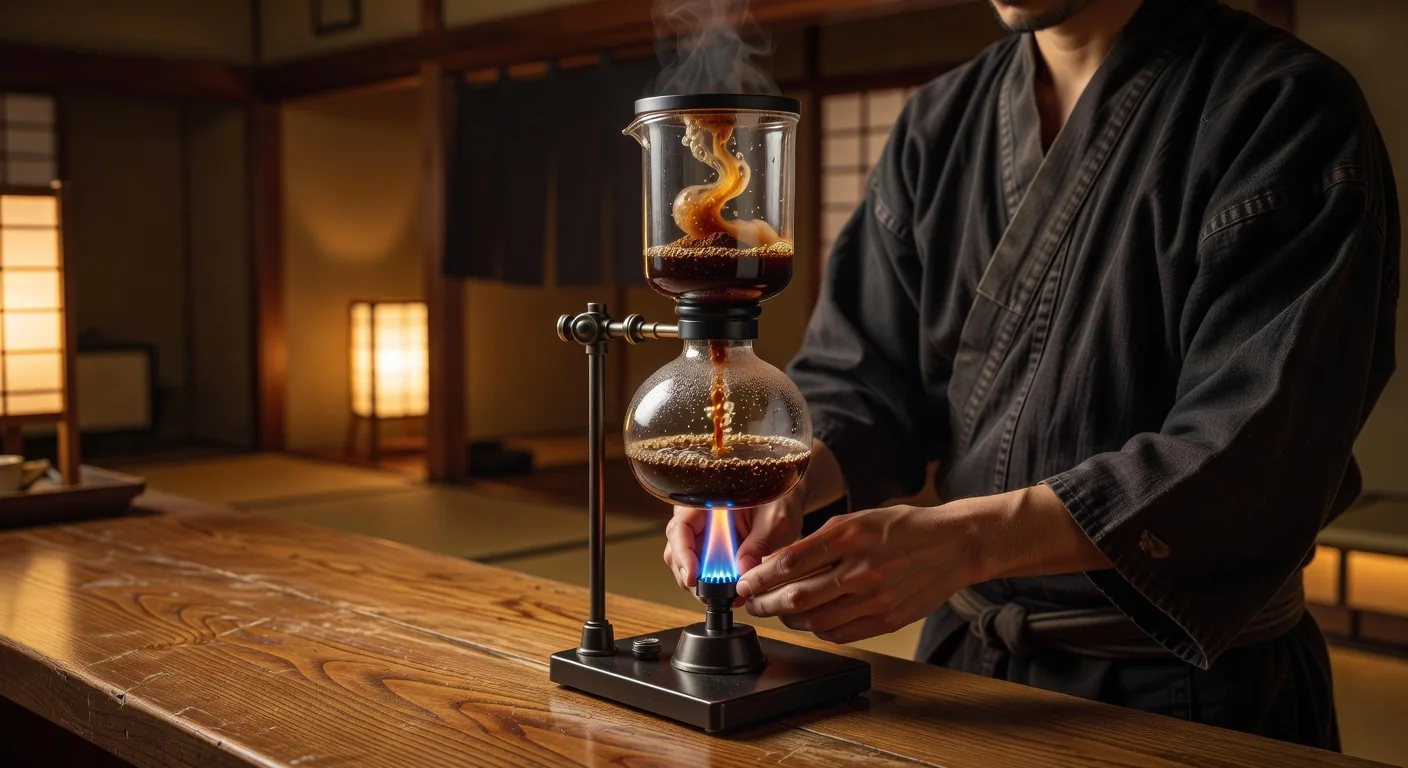
Siphon Brewing
The siphon — or vacuum pot — is the crown jewel of Japanese café theatre. Originally a 19th-century European invention, it was perfected and popularised in Japan's kissaten culture, where the theatrical bubbling and vapour-driven extraction became inseparable from the café experience itself.
The method produces a clean, bright, almost tea-like clarity in the cup. The absence of paper filtration allows the coffee's full aromatic oils to be expressed, creating a body and texture distinct from any other method.
How to Brew Siphon Coffee
Follow this method used by Tokyo's finest kissaten baristas.
- 1
Prepare Equipment
Attach the cloth filter to the upper bowl funnel. Rinse with hot water to remove any off-flavours and pre-heat the vessel.
- 2
Fill Lower Chamber
Add 240ml of water at room temperature to the lower globe. Place it on the stand over your heat source (butane burner or halogen).
- 3
Add Ground Coffee
Insert the upper bowl. Add 18g of medium-ground coffee (aim for coarser than V60, similar to French press). Distribute evenly.
- 4
Wait for the Rise
As water heats, vapour pressure forces water up into the upper bowl. When almost all water has risen, reduce heat to maintain a gentle simmer.
- 5
Stir and Brew
Stir gently in a figure-8 motion. Brew for exactly 60 seconds, stirring once more at 30 seconds to ensure even extraction.
- 6
Remove Heat & Serve
Remove the heat source. Vacuum pressure draws the liquid back down through the filter. Serve immediately in pre-warmed cups.
Pro Tip from Tokyo's Kissaten Masters
Use a bamboo paddle instead of a metal spoon for stirring — it reduces static charge that can affect extraction quality. This is the preferred tool at Tokyo's most revered siphon bars.
Hario V60 Pour-Over
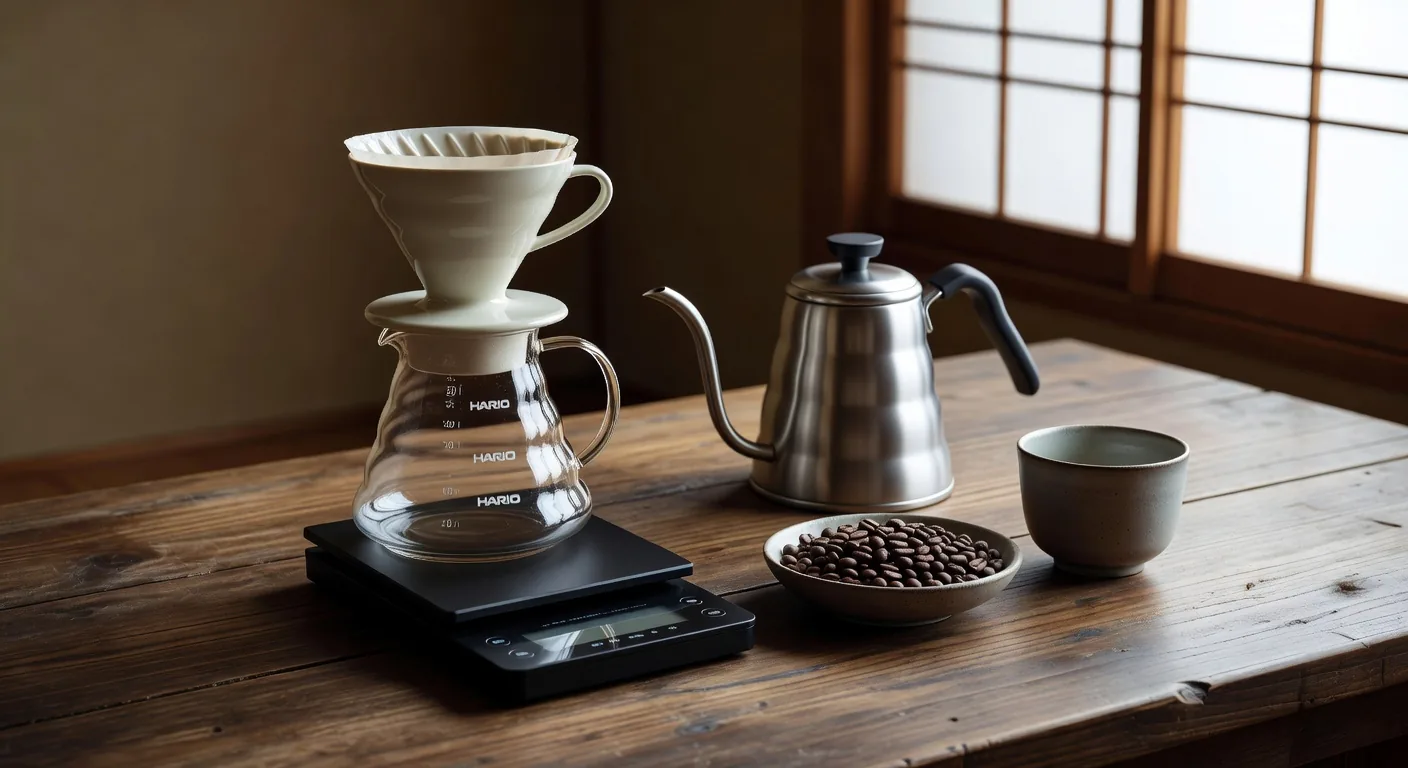
Invented by Hario in 2004, the V60 pour-over drip is now Japan's most iconic contribution to global specialty coffee. The 60-degree angle cone, spiral ribs, and large single hole give the brewer unprecedented control over extraction speed and intensity.
Japanese baristas have elevated the V60 into a meditative practice: every variable — water temperature, grind size, pour speed, bloom timing — is tracked and refined in pursuit of the ideal cup. The result is clean, bright, and complex beyond any other method.
Mastering the V60
The four-six method developed by World Brewers Cup champion Tetsu Kasuya has become the gold standard for home and café brewing alike.
- 1
Grind Fresh
Grind 20g of coffee to medium-fine (similar to coarse sea salt). Use a quality burr grinder — this is the single most important variable.
- 2
Rinse the Filter
Place a paper filter in the V60. Pour 100ml of boiling water through it to remove papery taste and pre-heat the dripper and server.
- 3
Bloom Pour
Add 40ml of 93°C water to saturate the grounds (2x the coffee weight). Wait 30–45 seconds for CO₂ to degas — this is crucial for even extraction.
- 4
First Large Pour
Pour in a slow spiral to 120ml total. This first 40% of water sets the acidity and sweetness profile of your cup.
- 5
Second Large Pour
When the water level drops to the grounds, pour to 200ml. The second 40% adjusts strength and body.
- 6
Final Two Pours
Make two pours of 50ml each to 300ml total, adjusting for desired strength. Total brew time should be 3–3:30 minutes.
The 4:6 Method Explained
Champion barista Tetsu Kasuya discovered that dividing the total water into two phases — 40% and 60% — lets brewers independently control taste profile and strength.
First 40% controls flavour: more water in early pours = sweeter; less = more acidic.
Last 60% controls strength: 2 pours = stronger; 3 pours = lighter, more delicate.
Japanese Iced Coffee
Japan pioneered the art of properly made iced coffee long before it became a global café staple. The Japanese method — brewing hot coffee directly onto ice — preserves aromatic volatiles that cold-brew methods lose over extended extraction.
- 1
Calculate Water Split
Use 60% hot water and 40% ice (by weight). For 300ml final brew: 180ml hot water, 120g ice directly in the server.
- 2
Stronger Grind & Dose
Grind slightly finer than your usual V60 setting. Use 25g coffee to compensate for the reduced extraction from cooler brew temperature.
- 3
Bloom as Normal
Bloom with 50ml at 96°C — slightly hotter than for hot coffee, as the ice will immediately begin cooling the brew temperature.
- 4
Pour Quickly
Unlike hot coffee, pour more quickly and continuously. The ice melts as you brew — aim to finish before all ice has melted.
- 5
Serve Immediately
The result is a vibrant, floral, intensely aromatic iced coffee. Serve over a single large ice cube. Do not dilute further.
Why Hot-Brewed Iced Coffee?
The aromatic compounds in coffee that create floral notes, bright acidity, and stone-fruit sweetness are volatile — they escape into the air at high temperatures. But when you brew directly onto ice, these volatiles are "flash-frozen" before they can escape, resulting in a dramatically more aromatic and complex drink than 12-hour cold brew.
This technique is standard at Tokyo's most celebrated specialty cafés. Ask for "kōri dashi kōhī" (氷出しコーヒー) to order it by name.
Aeropress — Japan's Favourite
Despite being invented in California, the Aeropress has found its most passionate following in Japan. The Japan Aeropress Championship draws competitors who travel with their own water, precisely measured to a specific mineral composition, to chase the ideal extraction.
- 1
Inverted Setup
Use the inverted method preferred by Japanese competition baristas. Place the Aeropress upside-down on the plunger extended to position 4.
- 2
Coffee & Water
Add 18g of medium-fine ground coffee. Pour 200ml of 84°C water (lower temperature is preferred by Japanese baristas for clarity and sweetness).
- 3
Steep
Stir 3 times gently. Place the cap with a rinsed paper filter. Steep for exactly 90 seconds — set a timer.
- 4
Flip & Press
Flip the Aeropress onto your cup. Press slowly and steadily over 20–25 seconds. Stop pressing before you hear the hissing sound.
Japan Championship Winning Notes
Recent Japanese Aeropress Champions have pushed the boundaries with unusual techniques: using sparkling water, brewing at 70°C, filtering through multiple layers, and even freezing the filter before use.
The results — when it works — are extraordinary: crystal-clear cups with intense aromatic complexity and a texture somewhere between tea and traditional espresso.
Kissaten Nel Drip
The nel drip — using a flannel (wool felt) filter — is the authentic kissaten brewing method, and it produces the richest, most full-bodied coffee of any filter method. The flannel absorbs some oils but allows far more body than paper filtration, creating a velvety, deeply satisfying cup.
- 1
Prepare the Nel Filter
Store the nel filter submerged in water in the refrigerator when not in use. Before brewing, rinse thoroughly with hot water and wring gently.
- 2
Coarse Dark Roast
The nel drip is particularly suited to dark and medium-dark roasts. Grind coarser than V60, like medium-coarse. Use 25g for 300ml.
- 3
Very Slow Bloom
Pour 50ml slowly in the centre. Wait 40–60 seconds — the bloom should be slow and thick, not explosive. This indicates fresh, quality coffee.
- 4
Circular Pours
Pour in small, slow, overlapping circles. Never pour on the filter edge. Keep water level low — this is a slow, patient method. Total time: 4–5 minutes.
- 5
Care for Your Filter
After brewing, rinse the nel thoroughly, never using soap. Store in clean water in the fridge. A well-maintained nel filter improves with use over months.
The Kissaten Philosophy
"A true master of nel drip can read the coffee's mood each day — how the bloom behaves, how the water flows — and adjust accordingly. The method demands presence."
— Yoshiaki Kawashima, Tokyo kissaten owner, 40+ years
The nel drip requires daily attention, knowledge, and patience — qualities that mirror the Japanese aesthetic of shokunin (craftsman spirit): the endless, joyful pursuit of mastery.
Brewing Parameters at a Glance
Compare the key variables for each Japanese brewing method.
| Method | Grind Size | Temperature | Ratio | Brew Time | Body | Difficulty |
|---|---|---|---|---|---|---|
| Siphon | Medium | 92–96°C | 1:13 | 5–7 min | Light-Medium | Hard |
| V60 Pour-Over | Med-Fine | 90–93°C | 1:15 | 2.5–3.5 min | Light | Medium |
| Japanese Iced | Fine | 96°C | 1:12 | 2–3 min | Light | Medium |
| Aeropress | Med-Fine | 80–88°C | 1:11 | 1.5–2.5 min | Medium | Easy |
| Nel Drip | Med-Coarse | 88–92°C | 1:12 | 4–5 min | Full | Hard |
Essential Japanese Coffee Equipment
Hario V60
The iconic ceramic dripper available in 01 and 02 sizes. The white ceramic version retains heat best.
Kinto Siphon
Japanese-designed vacuum brewer combining laboratory aesthetics with café performance. Popular in Tokyo kissaten.
Acaia Pearl Scale
The preferred scale of Japanese competition baristas. 0.1g accuracy and built-in timer for precise brewing.
Takahiro Kettle
Japan's most celebrated gooseneck kettle. The long, thin spout allows exceptional pour control and flow rate.
Commandante Grinder
Favoured by Japanese pour-over champions for its exceptional consistency. The red clix burr adjustment system is legendary.
Nel Filter
Flannel cloth filter for the traditional kissaten drip method. Hairo and Hario make the most respected versions.